Saturday, 9 January 2016

Elephantine coat of arms in Cutler Street, City of London


I spotted this magnificent elephantine coat of arms on the side of an office block on the corner of Cutler Street, London EC3 (it's around Minories), in the neighbourhood that my day job just moved out of.

I'm guessing it's something to do with the Worshipful Company of Cutlers, as suggested by the crossed swords, and that the elephants are something to do with the ivory handles that posh cutlery once had. Although I heard that lower quality ivory stuff like piano keys, in the US at least, tended to be made from hippo's teeth or walrus ivory rather than the quality stuff made out of dead elephants.

Tuesday, 29 December 2015

Crowdsourced TetZooCon 2015 report

TetZooCon 2015 back in November was a great success and a lot of fun, I only regret I wasn't able to stay 'till the end. Naturally, Pygmy Elephants was on sale throughout the day at a discount. (Extra links will be added to this post shortly.)

The venue was the London Wetlands Centre in Barnes, which must have London's most spectacular view from a Gent's toilet's window, even on a very rainy day like the day of TetZooCon.

First on was TetZoo instigator Darren Naish, on "The Evolution of Sea Monsters", and some of ridiculous lengths cryptozoologists have gone to in order to try to fit a vast range of one-off sightings into known zoology, often including hypothetical loosely species based on the fossil record but given a bizarre (and evidence-free) evolutionary spin in an attempt to accommodate them (clumsily) into known zoology.

I particularly liked Naish's "cryptozoological pyramid of inferences":


I was on next, speaking on, you guessed it, pygmy elephants. I'll leave the audience - both in the room and monitoring it via Twitter - to summarise my talk.


This included Loxodonta pumilio, an alleged pygmy elephant species, a specimen of which was once on show at Bronx Zoo. Although when he died and his remains went the American Museum of Natural History in New York a century ago, they were pretty convinced he was a bog-standard juvenile forest elephant.


"Congo", as Bronx Zoo's "pygmy elephant" specimen was known, is regarded as the best evidence for a pygmy elephant in uncritical internet regurgitation circles, but few realise that he was an infant at the time. The talk was an opportunity to show some rarely seen "before" and "after" photos that make "Congo" seem less like a pygmy after all...

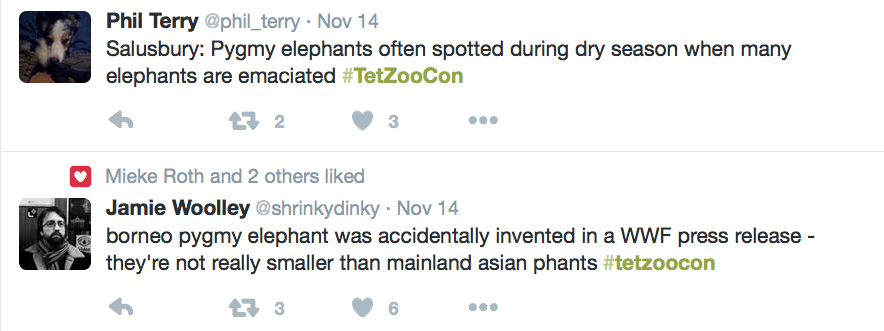
It's always interesting to see what engages the punters most, and at TetZooCon it seemed to be:

World Wildlife Fund Malaysia accidentally upgrading its Borneo (Asian) elephants to "pygmy elephents" in a press release (more on this here.):


(Paleo-artist Jon Conway is co-instigator of TetZooCon.)


The discussion of how much smaller Borneo elephants are than mainland Asian elephants prompted a virtual exchange with Dr Victoria Herridge, the Natural History Museum's discoverer of Mammathus creticus (and more recently another Mediterranean pygmy elephant), as well as the presenter of Mammoth Autopsy. It ended with a virtual wave to me from Tori.


The revelation that miniature, fist-sized "pygmy elephant" talismans change hands in Thailand and Burma for a lot of money, and their extraordinary source, caused a lot of excitement:


As did the assertion, put about by British big game hunter WR Foran and others, that perfidious French ivory hunters invented the whole "pygmy elephant" thing as a scam to circumvent regulations banning the shooting of juvenile elephants, by claiming that they'd just shot adult (made-up) pygmies instead:


Punters also found the idea of fossil Mediterranean pygmy elephants having litters particularly cool. In answer to a question, I explained that the Spignallo Cave site in Sicily yielded lots of pygmy elephant skeletons, of which many were juveniles or infants. This suggests a high level of infant mortality, and the bit about pygmy elephants having litters of several young was speculation based on this. (Modern African elephants have only one calf at a time, with a gestation period of almost two years. There's a life reconstruction of a juvenile Elephas falconeri here and a "fossil pygmy elephant identification chart" here.)


One of the audience identified with the Sicilian fossil pygmy elephant Elephas falconeri (aka Paleoloxodon falconeri) in particular, as he was from Sicily too (or at least from Italy). (Although his photo actually shows the pygmy stegodon Stegadon floriensis on the left, from Indonesia. Elephas falconeri is here.)

There was also Twitter chatter about "hoaxes involving young", particularly those perpetrated by circus manager PT Barnum, and Ringling Bros Barnum and Bailey's Circus, who had several dodgy pygmy elephants in their menagerie:


The bit about forest elephant females, from their late teens upwards, adopting the orphaned infants who had lost their mothers to poachers after they had weaned also provoked responses. This is in the Dzanga Clearing study of forest elephant behaviour, carried out by the Wildlife Conservation Society in the Central African Republic, which lasted well over a decade. Orphan savannah elephant infants, by contrast, invariably don't survive. (It's thought that a 1982 photo from Congo Brazzaville of a herd of small elephants, with young, is in fact a herd of infants orphaned by poaching and adopted by teenage females. You'll have to read Pygmy Elephants for more information, it includes a reproduction of the 1982 photos of the Congo-Brazzaville alleged pygmy elephant herd.)


There followed Jessica Lawrence-Wujek's talk on why Ichthyosaurs are the coolest reptiles of the Mesozoic. The more you study Ichthyosaurs, the more bizarre they get, particularly their paddles. These started life as the fingers of a limb, but these seem to have sprouted more and more bits out of the sides of what used to be digits as they evolved. They were creatures of the "shallow seas" - seas of around 100 feet deep at the most, but their big eyes suggest they may have been diving further into the dark depths of the Mesozoic waters.

Urban birder David Lindo described how his "Great British Bird" competition elected the robin as Britain's favourite bird - appropriate, as robins behave differently in the UK than on the European mainland. On the Continent, they're forest birds that follow deer or bison, waiting for the to churn up the bugs they feed on. Only in Britain are they garden birds that look to human gardeners to turn up bugs for them. He described the awkward silence in a North American bird hide when he shouted excitedly about seeing a particular type of rare tit. "We call it a titmouse or a chicadee", a North American birder eventually told him.

Vicky Coules recounted The Future is Wild, an After Man-style animated series about the animals that inherit the Earth after we leave (in spaceships to go to a nicer planet, apparently, at the behest of the American network funding it.) Elephantine megasquid colonise the land looking very much like HP Lovecraft's Cthulu. An elephant seal-like giant flightless gannet colonised the frozen regions. Mammals are consigned to history, the last one being a hamster-like "pog" kept as food by seed-gathering spiders. The future Earth includes an Antarctic rain forest, which reminded me of the "Strontium Dog" story from 1980s 2000AD sci-fi comic in which mutant bounty hunters land in an Antarctic rainforest (the result of human-made climate change) and encounter fauna including "monkey-gators".

There then followed the paleoart session on which Naish, Conway and Mark Witton (they all know their pterosaurs!) led us in an illuminating life reconstruction exercise. We were given deliberately badly done cast of one of the Solnhofen pterodactyl casts (one of the people on my table had actually been to Solnhofen) and asked to draw it as a bird, a bat, a reptile or whatever the features suggested. My hopping moorhen with teeth that couldn't fold its wings fully and that had vestiges of fingers used as sort of whiskers to detect wind direction didn't make the top five. Then I had to dash off on Mystery Animals of Suffolk business, I very much regret.

Both Love in the Time of Chasmosaurs and the Scientific American TetZoo blog have excellent reports on TetZooCon 2015.


Sunday, 8 November 2015

Pygmy Elephants at TetZooCon 2015 - imminent!


John Conway's excellent TetZooCon icon of myself as an elephant-bodied "Tetzooconian" does give me a rather out-of-date hairstyle! Copyright: John Conway, reproduced here with his permission.

I’m a speaker at TetZooCon 2015 on Saturday 14 November, speaking on Pygmy Elephants.

TetZooCon is the brainchild of Dr Darren Naish of TetZoo (Tetrapod Zoology), Scientific American’s most popular blog, and paleo-artist John Conway (check).

It’s all day Saturday at the London Wetlands Centre, London Wetland Centre
 Queen Elizabeth Walk
, Barnes, London SW13 9WT. Tickets, if there are any still left, are here.

I am very humbled as a mere journalist with a humanities degree to have been invited to speak to an audience with an intimidating large proportion of proper scientists - zoologists and palaeontologists in particular!

My talk will whizz through some of the alleged modern pygmy elephants, including some that weren’t in the Pygmy Elephants book that I’ve stumbled across since the book came out. (Examples here and here.)


Here’s the abstract I sent to Dr Darren Naish, who organises TetZooCon:

Living pygmy elephants?
Matt Salusbury, freelance journalist @Pyg_Eleph


The prehistoric pygmy elephants, pygmy stegodons and pygmy mammoths have been formally described to science and are well-documented, but claims have also been made in modern times for the existence of living pygmy elephants.
There have been sighting, photos, cine film and shootings of – allegedly – adult elephants said to be only five foot (1.52 metres) tall from Central and West Africa, and more recently from south India.

There are alleged specimens – bones and skins of pygmy elephants in museums or collections, but on closer examination these turn out to be not all that they seem.

Some are honest misidentifications, a few are hoaxes and some of the much-quoted written sources used as supporting evidence have become somewhat garbled in the retelling.

Zoologists, cryptozoologists and eyewitnesses have described a variety of alleged pygmy proboscideans – including Pliny the Elder’s “bastard elephants,” the respectably Latin-named Loxodonta pumillio, the wakawaka of the Belgian Congo, “kallana”, the “stone elephant” of Kerala, esesmasas (the “incarnation of the Devil” from Spain’s tiny African empire), “scimitar-tusked” aggressive pale pygmy elephants of the Kibali-Ituri forest, the sama oule reddish coloured pointy-headed Malian elephants, as well as some dubious animals advertised as miniature pachyderms by the great circus impresario PT Barnum. The actual evidence for the existence of these animals, however, is unimpressive.


Naturally, Pygmy Elephants will be on sale at a discount at TetZooCon. I'll be ending my talk (a manageable half-hour) with a quick pitch to the proper scientists for collaboration on a couple of projects, only one of which I can name here, a "Mighty Giant.. dig'd up" in 1652 that is most likely the bones of an mammoth or elephant.

Let's just say the other is something to do with mystery animals in Suffolk, and features the world premiere of a very couple of minutes of some kind of animal captured on CCTV somewhere not far from the South Norfolk/North Suffolk border!

The references from my talk will be linked from this page later. Humorous anecdotes from the day will be on the Pygmy Elephants twitter feed.

Monday, 21 September 2015

Finally found a photo of an elephant ploughing


In - of all places - the Museum of East Anglian Life, Stowmarket, Suffolk - I saw this photo on display. Its source wasn't given, beyond 1879, India. (It was part of a hall displaying ploughs and other agricultural machinery.)

Both Sukumar Raman and Jacob Cheeran, Asian elephant experts I talked to, said they'd heard of, or seen photos of, ploughing elephants. Cheeran said he'd seen early 20th century photos of ploughing elephants in Burma. He said the biggest problem with ploughing elephants would be the gears for the plough, it being such a big animal it would be hard to set up the gears. (Most contemporary ploughs, including those pulled by bullocks in India, are assumed to have gears these days.)

Pliny the Elder in his Natural Histories talks about "nothi", "bastard elephants" used for ploughing in India, assumed to have been smaller elephants. But as you can see from the engraving, it's a massive, adult male tusker pulling an absolutely huge plough. It's quite possible, of course, that the drawing's not accurate. The ploughmen (ploughmen-mahouts?) don't look particularly like farmers to me, and the elephant, with its straight tusks, isn't particularly well rendered.

Friday, 17 July 2015

Pygmy Elephants talk at TetZooCon - 14 November 2015

I've just been confirmed as a speaker at TetZooCon 2015, Saturday 14 November at the London Wetlands Centre. Naturally, I will be flogging some books there. More details follow.

Saturday, 7 February 2015

Quite big for pygmies - Fortean Times review of Pygmy Elephants

This first appeared in Fortean Times, FT 320 (November 2014) and is reproduced here with the permission of both the review's author, Dr Karl Shuker and Fortean Times editor David Sutton.

Quite big for pygmies

Unknown animals are not generally as conspicuous as widely
photographed but oddly shadowy pygmy elephants


Pygmy Elephants - On the Track of the World's Largest Dwarfs

Matt Salusbury
CFZ Press (Bideford), 2013
Paperback, 314 pp, illustrated, glossary, bibliography, index, ISBN 9781909488151
FORTEAN TIMES BOOKSHOP PRICE £12.00


The Tasmanian wolf or thylacine is often dubbed the world's most common extinct animal on account of the number of unverified sightings since the last confirmed specimen died in 1936. By that reckoning, pygmy elephants must rate not only as the world's largest dwarfs but also as the world's most conspicuous unknown animals, since alleged pygmy elephants have been filmed in the wild close-up and with a clarity unlike the ill-defined blobs normally characteristic of cryptid images.

Specimens have been kept in major zoos around the world and preserved in museums after their deaths, yet their zoological status has remained controversial. Faced with such a shadowy, scientifically anonymous history given such animals' corporeal presence (a history stretches back over a century in terms of Western knowledge, let alone the countless ages of native knowledge), it is perhaps inevitable that it has taken until the second decade of the 21st century to have an entire book devoted to pygmy elephants.The wait has been worthwhile.

The first four chapters of this fact-fest on pygmy elephants documents the fascinating range of island-endemic prehistoric forms, some of which survived into (semi-) modern times, and the tendency towards dwarfism or gigantism that frequently occurs as a consequence of insular evolution. The proboscidean examples merit a book of their own. Chapter 5 sets the scene for documenting the African pygmy elephant by revealing how taxonomic splitters delineated the African forest elephant from the African savannah elephant. They promoted it to a separate, second African species of elephant in its own right, thus providing a precedent for discovering a 'new' species in the modern scientific age.

Chapters 6-8 are devoted to the African pygmy elephant, documenting its history and recorded specimens. Some researchers have categorised it as a valid species in its own right; others have discounted it as

merely a juvenile form or even a dwarfed, teratological version of the forest elephant. (This mirrors the early scientific history of the pygmy hippopotamus relative to the much larger common hippopotamus). Also included here is a detailed account of the West African water elephant, a semi-aquatic cryptid that has long been a favourite of mine.

Chapters 9- 10 focus upon the kallana, or Asian pygmy elephant, in its permutations and document the bizarre mouse-sized 'water weevil' elephants - small but supposedly deadly mini-beasts that occasionally turn up in dried form on eBay. The author visited India to interview kallana eyewitnesses and obtained photos previously unpublished outside the subcontinent. There is much new information here in addition to the historical literature.

The final chapter considers the likelihood that pygmy elephants exist; the author concludes that they do not. How, then, can the specimens and filmed evidence be explained? To discover how he seeks to resolve this paradox, you'll have to read the book! There are illustrations throughout the text, many of which were new to me.

There is a useful glossary, an illustrated identification guide and a detailed bibliography. But what about websites that were consulted during research and have subsequently vanished? This is a bane for authors in the Internet age, but thanks to an addendum to the bibliography, readers can rediscover these ostensibly lost sources, which is great news.

It's customary to find things to gripe about when reviewing a book, but I found little. One minor source of frustration, however, is that the list of contents does not include page numbers for the chapters (a contents page with numbers is here, sorry!), so the only way to find, say, Chapter 6, is to flick through the book. There is the inevitable sprinkling of factual errors that pop up in any work bristling with facts and figures. To quote just one example: it was Maurice Rothschild, not Baron Walter Rothschild, who purchased an anomalous tusk in an Addis Ababa ivory market in the early 20th century.

Overall, however, this is an absorbing read. I do not agree with all of the author's conclusions about the validity or otherwise of pygmy elephants. However, his diligent compilation, presentation and analysis of the hitherto disparate history and facts about these enigmatic animals, plus his own addition of important new data to their archive of material as exclusively revealed in this book, make it a publication very deserving to be read by everyone interested in such creatures. If you're looking for information on stature-challenged pachyderms, this is the publication to consult.

Karl Shuker

Fortean Times Verdict

ALL YOU NEED TO KNOW ABOUT VERY SMALL ELEPHANTS - 9/10

Monday, 29 December 2014

No Christmas tree would be complete without... dinosaurs!


In place of a fairy I have a Utahraptor on the top of my tree, with a Dilophosaurus climbing towards it. And yes, if you look closely, that is a Dalek between them!


As you can see, the dinosaurs on my tree are mostly therapods. (Their sticking-out arms mean they grip better round the branches.) But can you spot the obscure South American prehistoric mammal on the left?


The tree with dinosaurs, with lights deployed.


Any what would a Christmas tree be without a pygmy elephant? This one's just over 2cm long.

For more on the Haringey Paleontology Museum in Exile collection, see here.

Broccosaurus Rex! Broccoli-eating sauropod dinosaur


Broccosaurus Rex! This broccoli-eating dinosaur, on packaging from a broccoli grower based in Lincolnshire, was spotted outside a village store in Reydon, Suffolk. I'm told the depiction of sauropods bouyed up by water is no longer considered accurate, and perhaps a paleobotanist could tell me whether broccoli was a contemporary Mesozoic plant? (Photo: Matt Salusbury)

Tuesday, 4 November 2014

Ringling Brothers and Barnum and Bailey Combined Circus' "herd of pygmy elephants" arrives in Springfield, Mass (1937)


Three "pygmy elephants" of the Ringling Brothers and Barnum & Bailey Combined Circus - named as Nuba, Bull and Loka - were reported by the Springfield Republican (Springfield, Mass.) of 18 June 1937 as arriving in town.

The first thing I noted from the photographs of these elephants (and from posters of them featuring drawings that I've seen, I'll add links later) is that the tusks look dodgy. They're way to long and straight for an African elephant (savannah or forest), reaching almost to the ground. They look like prosthetic add-ons that would fit over the very small tusks juvenile African elephants would have. (There's also a possibility that the circus had found some African savannah elephants showing "precocious tusk growth" – there's a photo of this in Pygmy Elephants.)

Two of these elephants are probably the same two specimens of "Abele" referred to in Exploration du Parc National Albert, Mission S. Frenchkop (1937-38) by Serge Frenchkop (Brussels, 1943). As I describe in Pygmy Elephants, discussing elephants in and around the Belgian Empire's National Parks system, Frenchkop's report notes that "Major Offermann distinguishes another, third type of Elephant, l'Eléphant Nain (dwarf elephant) known in the region of the Elephant Domestication Station with the vernacular name of "Abele", and which lives to the North of Api and does not measure more that 1m 30 or 1m 40 in height. The general aspect of "Abele" would be that of Loxodonta africana cyclotis, save for the size. This would seem to permit me to suppose that the "Abele" is nothing more than a young "Tembo" [forest elephant in the local language]. M. Offermann who has had the occasion to observe the growth of two "Abele" admits, elsewhere, to these having been sold to America, he could not continue his observations." No mention is made of extraordinary long tusks on "Abele", which you would have thought Offerman would have commented on.

Contemporary posters show that one of the Ringling Brothers Barnum and Bailey Circus attractions touring the US around 1936-38 was a "Herd of the Smallest Fully Grown Pigmy Elephants on the Face of the Globe!". This, and the above newspaper article, make me wonder if it's possible that two of these could have been the young "Abele"-type elephants from the area around the Domestication Station whose growth Monsieur Offerman was no longer able to observe.

The African mahouts ride these little elephants in exactly the same way as in Armand Dennis's 1936 documentary film Wheels Across Africa, in which mahouts ride adult African forest elephants from the Domestication Station that pull Dennis's Dodge truck across a river.

Thanks again to Richard Muirhead for finding this article.

Wednesday, 29 October 2014

EATS 150 BANANAS A DAY does this pygmy elephant...


"EATS 150 BANANAS A DAY does this pygmy elephant whose home is London Zoo. His midgeship is less than three feet high" and said the be the first specimen at London Zoo. "It is not a baby elephant" and comes from "French Gaboon" and eats "nothing but bananas". That's according to the Plain Dealer of Cleveland, Ohio, November 1 1922 (above). It gives as a source "Wide World", which appears to be Wide World magazine.

In the book Pygmy Elephants I relate how the The Wellington, New Zealand Evening Post of 27 January 1923 quotes "L.G.M" in the London Daily Mail as saying there was a three-foot (1.5m) baby "pygmy elephant" deposited in London Zoo by a Miss Cunningham, who obtained him from "French Gaboon" (Gabon).
The article claims, "for the first time on record, a baby pygmy elephant has just reached the UK, and that it eats bananas, of which it needed 150 a day. (Exactly the same headline as in the Plain Dealer. The little elephant broke his leg when captured and this had set "rather badly".

In the Evening Post article, there was - for a change - some indication of how big the 150-bananas-a-day "pygmy elephant" was eventually expected to be. Both his mother and father were, reportedly, shot when the little one was captured. His father was "only six feet high (1.8m) and his mother was six inches shorter still" (making her 5ft 6 inches, 1.67m). This assumes the male and female elephant observed around the unnamed "pygmy" when he was captured were his parents. As extensively described in Pygmy Elephants, forest elephant society is a bit more complicated. The other elephants shot on the occasion of his capture could just have easily been his older siblings, and the female could have been his teenage stepmother.

As for the age of 150-Bananas-A-Day Boy himself, it was given as three years old, probably based more on the time elapsed since his capture than anything else. Assuming it's correct, three feet is well within the expected range of a conventionally-sized forest elephant of that age.

It's possible that the mention of the elephant calf's broken leg could be a garbled reference to the male "pygmy elephant" known as "Congo", whose leg was broken on capture but healed, but later got infected? Or could it have been the female "pygmy elephant" Tiny, whose gender had been garbled, on her way to the Bronx via London?

Thanks to Richard Muirhead for finding this article.


Tuesday, 14 October 2014

Dortmund Zoo's director on a climbing Sumatran elephant and a very small elephant in Giza, Egypt


Naeema, an adult female (forest?) elephant in Giza Zoo, Egypt in the 1990s, only 1.8 metres high, and understood to be still living in that zoo. Photo: copyright Dr Frank Brandstätter

I recently got some unexpected Pygmy Elephants fan-mail from Dr Frank Brandstätter, Director of Dortmund Zoo.

Dr Brandstätter in the 1990s did some research for zoologist Wolfgang Böhme, who is mentioned in Pygmy Elephants in the context of 1980s reports of sightings of African pygmy elephants - "Zwergelefanten" in German sources co-authored by Böhme. Brandstätter notes that the 2005 standard work Mammal Species of the World lists Loxodonta pumilio (the alleged African pygmy elephant species or sub-species) "as a synonym for L. cyclotis" (the African forest elephant).

Pygmy Elephants looks into the great agility attributed to the alleged Asian pygmy elephant kallana. On the agility of one adult Asian elephant in particular, Brandstätter says, "when I was responsible for Neunkirchen Zoo, a small zoo in the Southwest of Germany, from 1995 to 2000 we had two Asian Elephants of which one, 'Chiana', was a female Sumatran Elephant (Elephas maximus sumatranus), aged approximately 30 yrs old by then. She had the typical features of a Sumatran Elephant: larger ears in comparison to the head, a shoulder height of 2 metres, a very light grey colouring and a flat forehead. She was very fond of climbing and even succeeded to climb and leave behind the massive steel fence (1.8 m) that surrounded the elephant enclosure."

"This she only did, when she was trying to reach interesting trees to far away for her to reach with the trunk. To climb the fence she had first to step with her forefeet on the upper steel bar and then to step with at least one of her hindfeet on the lower steel bar. When she was up there she simply lend over and fell to the other side. It was interesting for me to see, how good a climber an elephant could be."

The other elephant in the enclosure, "Samba", a female Indian Elephant (Elephas maximus maximus) was bigger and with typical outlines like the domed head and a high shoulder, and smaller ears, but approx. 2.4 m height, never tried to climb the fence."

"Both elephants had no problem climbing the steep and sandy hill, that was in their enclosure. They even liked to dig terraces in the slope where they could lay down and get up comfortably, which was much easier than lying on a flat surface." Both elephants have since died. He described this in a German-language article The latter I described in an article (BRANDSTÄTTER F. (1998): "Elefanten in Neunkirchen", Zoo magazin Süd Herbst/Winter 1998: 40-43. ). Sumatran elephants are regarded as the smallest accepted Asian elephant sub-species.

Brandstätter also described "a surprisingly small" female African elephant named Naeema, "as far as I could find out... still alive" in Giza Zoo (now Egypt Zoo) in Cairo, Egypt. He first encountered Naeema in 1992. Brandstätter soon came to regard Naeema as a forest elephant, based on her "reaching only 1.8 m in height, had a flat head and longer face and the typical round ears." He was kind enough to give me permission to reproduce his photo of Naeema above. 1.8 metres for an adult forest elephant is very small indeed, I've not heard any accurate measurements of any adult forest elephants being that small.

There's more from Brandstätter on the German-language Wesen der Edda. Band I. Was die Edda bisher verschwieg by archaeologist Rainer Mekelburg, on the possibility that "raging wild boar" in the mythology of both the Greeks and the Vikings were based on pygmy elephants or pygmy mammoths, and a reference to a small African elephant used for ploughing that appears in an illustration in Sebastian Münster's Cosmographia from 1545. A post on this will follow shortly.

9 out of 10 for Pygmy Elephants in Fortean Times review

Dr Karl PN Shuker's review of Pygmy Elephants in the current issue of Fortean Times (FT 320, November 2014):

"If you're looking for information on stature-challenged pachyderms, this is the publication to consult"

ALL YOU NEED TO KNOW ABOUT VERY SMALL ELEPHANTS, 9/10

Full review to follow on this website.


Tuesday, 26 August 2014

White-skinned, super-aggressive scimitar-tusked pygmy elephants from the "zone of mystery"

While I was at this year's recent Weird Weekend, Richard Muirhead gave me a photocopied chapter of a book he'd discovered completely by chance, his hairdresser had it on display in an ornamental bookshelf in their salon in Macclesfield.

The book was Great Mother Forest by Attilio Gatti, published by Hodder and Stroughton, London (no publication date given, but it seems from the text to have been some time around 1937.)


The book describes the four-feet high (1.21 metres) white-coloured, super-aggressive pygmy elephants of the Kibali-Ituri forest, the "zone of mystery" in the Belgian Congo. (Gatti was Belgian, Richard told me, despite having a very Italian-sounding name. Italian immigrants settled in large numbers in the industrial heartlands of Belgium in the late nineteenth century, there are still identifiably Italian communities in Belgium.)

According to Gatti, an aggressive herd of these pale pygmy elephants, looking for a fight, had attacked the Belgian colonial District Commissioner Hackers in the forest, forcing him to hide up a tree for many hours. These elephants had very dense, sharp-pointed tusks, with a reddish tinge to them, some of the tusks Gatti had been shown by the "natives" had streaks of dark red or even purple in them.

Great Mother Forest also described how "some months ago" and official in Lubero (somewhere else in the same region of the Belgian Congo) argued over the price of a permit to hunt and kill "one elephant" with a local chief who presented four tusks from the same elephant. (This appears to have been a conventional-sized elephant, not a pygmy.) Gatti said the skull with the four tusks ended up in a museum, possibly the Terveuren Museum near Brussels. (This could be this specimen , and it's a similar story to the one described by Armand Denis in On Safari: The Story of My Life, (see Pygmy Elephants, page 12.)

Gatti's super-aggressive pygmy elephant has many characteristics in common with the forest elephant – a supposedly more aggressive temperament and denser, thinner, pinkish-grey tinted tusks being a characteristic of the forest elephant Loxodonta cyclotis. It would be tempting to put this down to a simple misidentification of the local forest elephants (L. cyclotis).

But there are some problems with that assessment. Firstly, forest elephants had become by the mid-1930s quite well-known among zoologists. Secondly, Gatti mentions three types of elephants known to the local Mambuti and Bandande "pygmy" tribes (ethnic groups of smaller than average forest-dwelling peoples) – savannah elephants (Loxodonta africana), M'zei, the feisty, four-footer pointy-tusked pygmy elephants, Somà, another variety bigger than M'zei but at around nine feet at the shoulder smaller than the savannah elephants, and about the correct height for a forest elephant.

In Gatti's opinion, the Somà elephant is of the sub-species Loxodonta knochenhaueri, a now discredited sub-species of elephant that's since disappeared from zoology catalogues. The now defunct elephant sub-species L.africana knochenhaueri, which described the type of savannah elephant normally encountered in Tanzania, was an invention of German zoologist Paul Matschie at the turn of the twentieth century, when he whittled down the 22 then prevailing sub-species of African elephant to just four. By the 1940s, L.africana knochenhaueri had gone from the zoological literature, replaced by just two types of known African elephant – L. africana and L. cyclotis.

The pygmy M'zei elephants were, according to Gatti, the male of the (sub-)species, while the noticeably smaller females were known as Malekwe. They were said to live in small herds, between 10 and 12 individuals. The Mambuti and Bandande peoples were very reluctant to enter the deep forest's "zone of mystery", so terrified were they at the prospect of the extraordinarily fierce M'zei pygmy elephants not only goring them with their scimitar-like tusks, but also repeatedly stomping on them in a very vindictive manner.

The reluctance of the Bandande and Mambuti guides notwithstanding, Gatti claimed he was actually able to see the M'zei for himself in Tchibinda Forest, from a distance - a group of these were "at play" by a river.

The M'zei, were, according to Gatti, not recognised by the Belgian colonial authorities. As colonial officialdom didn't accept that some of the small tusks the "natives" tried to sell them were from adult pygmy elephants, they assumed these were instead merely the tusks of juvenile elephants – illegal for sale under Belgian colonial regulations. So the natives were forced to hide these "too small" tusks, selling them clandestinely to the "ivory workers" that occasionally came round, for a knockdown price. A possibly last-minute footnote by Gatti adds that the "most recent decree" of April 1935 "mentions" pygmy elephants for the first time.

This decree by the Belgian administration "mentioning" pygmy elephants would be consistent with the conservation laws of today's Democratic Republic of the Congo. This law, possibly inherited from Belgium, decrees that the éléphant pygmée (pygmy elephant) shall enjoy the same complete protection as other types of elephant. See Pygmy Elephants pages 115-166 for pygmy elephant references in the current conservation laws of the Congo Basin states.

Locating pygmy elephants in the "Kabali-Ituri" forest is interesting. As described in Pygmy Elephants (page 184), there was a lot of traffic on bulletin boards used by conservation people a couple of years back about the forest elephants of what's now known as the Iture-Uélé being some sort of unique eco-type. These Iture-Uélé elephants were said to be particularly hard to photograph in their habitat, and if you saw them at all in their deep forest environment, it was as a "dark shadow moving."

Also described in Great Mother Forest is "Lord Rothschild" (Baron Walter Rothschild) showing Gatti a variety of elephant tusks in his museum at Tring (then the Zoology Museum, shortly thereafter to become an annex of the British Museum, Natural History) with Rothschild demonstrating to Gatti how the tusks of "pygmy elephants" differed from those of other elephants.

Rothschild was a believer in pygmy elephants it seemed, and was apparently able to tell the age and gender of an elephant from its tusks with great certainty – which much more certainty than we are able to do today, it seems. We know have the technology to tell where in Africa elephants came from, based on their isotopes, but gauging the age and gender of an elephant from its tusks remains an inexact science, so I have to say I'm a little dubious of Rothschild's confident assessments.

Gatti led ten expeditions to Africa up to 1945, and was one of the first Europeans to see an okapi. There's a very short biography of Gatti here and a photo of him here.

I also got an update from Lars Thomas, regarding the Camerooni "pygmy elephant" specimens rediscovered in the University of Copenhagen's museum. (See Pygmy Elephants pages 151-155.)

I'm afraid the news is not good. Lars thinks his team now know where the missing skin of one of the elephants is (it was stored somewhere "off-site" and was unaccounted for), and a DNA test on the skin would be much easier and less destructive than DNA testing the tusks, skull or teeth. But there have been cutbacks at the University, and the prospect of there being resources available to DNA test any of their Camerooni "pygmy elephants" is becoming more remote.

Tuesday, 12 August 2014

Pygmy stegodons on "Twilight Beasts"

There's a recent guest post from me on Twilight Beasts, the go-to blog for "neglected Pleistocene taxons". It's on pygmy stegodons, and features extracts and illustrations from Pygmy Elephants.

Sunday, 29 June 2014

Karl Shuker on water elephants of the Congo

Karl Shuker's blog has a recent post on water elephants of the Congo, which gives a plug to "British cryptozoological investigator Matt Salusbury in his extremely comprehensive book Pygmy Elephants (2013)" Dr Shuker feels that "if this cryptid has been described accurately in those sightings... its morphological differences from Africa's typical, predominantly terrestrial elephants are, I feel, much too profound" for it to be any member "Africa's modern-day Loxodonta species" and that it would have to be something altogether different, possibly some much more ancient relatives of the modern elephants, long thought extinct.

Fortean Time's reviews editor confirms that Karl is on the case with a review of Pygmy Elephants, which will appear shortly in FT.

Karl is also on the case with his own "enigmatic but seemingly long-lost specimen, the Rothschild-Neuville mystery tusk" and will publish something on this in his blog soon. Followers of the Pygmy Elephants Twitter feed will know I am also on the case with this, and will present a talk on it at this year's Weird Weekend. There's a lot of crowdsourced assistance coming in from the zoology and paleontology communities, particularly on museum accession logs.


Monday, 23 June 2014

Book signing at Weird Weekend 2014


There will be a book signing of Pygmy Elephants at 1pm on Sunday 17 August, squeezed in straight after my Weird Weekend talk (12 noon-1pm). This is on the "tooth of enigmatic origin" found at Addis Ababa ivory market by Baron Maurice de Rothschild's East Africa expedition of 1904. (Image above - for non-commerical purposes.)

For background to the talk, see here. The enigmatic tooth - thought by some to resemble the tusk of the extinct prehistoric elephant relatives the dinotheres - is touched on briefly in Pygmy Elephants, but will be dealt with in much more detail in my WW talk. (Weird Weekend's at a different venue this year.)


Wednesday, 21 May 2014

Mammoths: Ice Age Giants at the Natural History Museum

First thing this morning I was at the press preview for "Mammoths: Ice Age Giants", which opens tomorrow at the Natural History Museum (NHM) London.

I regret I've got no photos. When I got there I found my camera was somehow damaged and wouldn't focus, there was a rather pathetic buzzing noise when I switched it on. The photos I took with it came out very blurry, so you'll have to rely on my written description of the event.

And I only had the opportunity to say briefly say hello to, and shake hands with Prof. Adrian Lister, the NHM's expert on mammoths, as he had a lot of interviews lined up, including one with a Japanese TV crew. Prof. Lister, along with Dr. Victoria Herridge, who was also at the launch, helped me out with contributions to Pygmy Elephants.

Lister said we are just at the beginning with DNA studies of mammoths, although we've already used DNA it to establish their hair was not red (frozen mammoths are often unearthed with red hair) but dark brown. The red is the result of decay over the years.

Global warming played a big part in the mammoth's demise, according to Lister, and led to retreating grasslands and encroaching forests. with human agency towards the end also being a factor. Mammoths moved into the same areas as humans at about the same time, as the environment opened up the same "pathways" for them to travel - out of Africa, into Eurasia and across the Bering Straits into the New World. We don't know for certain whether the many "mammoth products" used by early humans were hunted or scavenged.

Lister also said that the current global warming we're experiencing means the permafrosts melt for longer, resulting in more mammoth discoveries in recent years than in the 200 years since the first recorded discovery in 1799. Another factor in the sharp rise in mammoth discoveries is "locals twigging that people are interested", as Lister put it, meaning that the peoples of Siberia are looking out for mammoth remains more, and reporting them when they find them. There remain an awful lot of mammoth tusks to be found in the soil of Siberia, he added.

In response to a question, Lister said of the legal trade in mammoth ivory that there's a debate about its ethics, and whether by satisfying demand it saves elephants, or by keeping ivory carving going it fuels the demand for the illegal ivory trade. Mammoth ivory is currently "not covered by CITES" as they're extinct, not endangered anymore.

There's a full-size Columbian mammoth replica in the exhibition, not much bigger than the biggest African elephants, with thin fuzzy hair only along its back and the top of its head. There's a Mammathus exilis pygmy elephant reconstruction (M. exilis lived on Santa Rosa island, off the coast of Santa Barbara, California.) The full-size M. exilis model has a long narrow skull and a domed head, and no fur, and surprisingly short tusks. It's about my height (6ft 3). Behind the M. exilis model there's a nice mural of M. exilis on the Santa Rosa beach, with elephant seals (about the same size) and pelicans.There are Mammathus creticus bits on display along with other Cretan microfauna. M. creticus was for over a century known as Elephas creticus, until Dr Herridge's research discovered it was in fact not a pygmy elephant but a pygmy mammoth - and one of the smallest, not much more than three feet high. Wisely, there no reconstructions beyond a painting at this stage.

There's a "bring me the head of a probiscidean" exhibit with the massive disembodied heads of some of the earlier elephant relatives, and you're allowed to touch them. The deinotherium has a huge thick short trunk and relatively tiny, and all the proto-elephant proboscideans have not much tusk showing beyond the gum.

And there were lots of lovely interative displays, and the extraordinarily preserved baby mammoth Lubyna was impressive, particularly the "brown fat" lump behind the back of her head, used to regulate body temperature.

The bronze miniatures of different elephants had the Columbian mammoth at around African savannah elephant size, and the woolly smaller, and the American mastodon I thought very elelphant-like, barely distinguishable from an elephant.

There was also a full-size in situ half buried mammoth skeleton sticking out of some earth, it was unclear whether it was real or a cast. There wasn't much wolliness in evidence, and the audio emphasised they weren't just woolly, they lived on four continents and across a range of climates.

The NHM shop (its Gift Shop and online shop) is currently without a 'retail buyer', they asked me to drop off a sample copy of Pygmy Elephants for their 'retail guy' to look at, and they will get back to me in the event they're interested in stocking it.


Monday, 28 April 2014

Report on a couple of Pygmy Elephants book launch events, and a vaguely related new project


The London launch for Pygmy Elephants on 13 March at the Big Green Bookshop was a big success, with thirty people dropping in during the course of the evening, and yes, I did shift some copies. Everyone who bought a copy got a little drawing of an Elephas falconeri skeleton from me on the title page, after I was desperately practising these at work earlier that day.

A proper palaeontologist turned up – Dr Darren Naish, of Scientific American's popular Tet Zo blog all the way from the University of Southampton, was in da house, with one of the London-based "@TetZoo possee", John Conway, paleoartist. I've since got wind of a Tet Zoo Con event upcoming. See here for the background to the Poundland komodo dragon model I ended up giving him on the night.

Also putting in an appearance was Oliver Simmonds, who I knew as Olly Simmonds at school back in the early 1980s, and who told me he has a new book on the way, after an absence of his name from bookshop shelves of a couple of decades – he wrote Delirium just after leaving university. And Rosanne Rabinowitz, author of Helen's Story - she's a character out of occultist Arthur Machen's The Great God Pan. Most of the NUJ London Freelance Branch committee were in evidence, and events were considerably enlivened shortly after-kick off by one of our number accidentally breaking a bottle of white wine. It turned out the Big Green's assistant behind the counter that night is in LFB too.

A former colleague from my English language teaching days back in the early Noughties attended, and Rosie from London Cryptzoology Club. There were even a couple of old enemies who seemed to be getting on well. We had apologies from Prof. Adrian Lister of the Natural History Museum's Palentology Dept, who has a regular adult education gig in Finchley on Thursdays.

Darren had heard the legend about Jumbo the elephant laying down his life to save the Tom Thumb elephant from that oncoming freight train at that marshalling yard on St John's Ontario in September 1885 – and I was able to confirm that it was just a that, a legend – possibly the sort of tall tale PT Barnum liked to make up for publicity purposes. Darren was also able to clear up the possible confusion between gaur (Indian bison) and water buffalo. I showed a slide of a herd of wild cattle thundering past in Neyyar Peppara Wildlife Sanctuary, reputed habitat of the kallana pygmy elephant of Kerala. Tracker Mallan Kani said they were gaur, but Mr
A. Marriott Hyde in a letter to Fortean Times cast doubt on Mallan's identification saying my photo showed water buffalo. Nope, said tetrapod zoologist Darren, they were most definitely gaur.


Definitely gaur, not water buffalo, apparently. Photo: copyright Matt Salusbury

The book reading at Freedom Bookshop in Whitechapel on Saturday 5 April was an altogether more surreal affair. None of my so-called friends who said they were coming turned up in the end, including some people who promised to come to the March Big Green event and didn't come to that either!

In the event, I ended up reading aloud extracts of Pygmy Elephants to a small audience mostly of Green and Black Cross legal support people (there were at Freedom there giving back-office phone support for arrestees at a Occupy anniversary demo in Trafalgar Square that day. In the event the plan to "Occupy Trafalgar Square" unsurprisingly didn't get off the ground, so they didn't have much to do.) One of their number was a trainee lawyer up from Liverpool, where she worked with one of the Hillsborough support groups.

One of the trainee lawyers said she laughed so much she was crying, but this was nothing to do with Pygmy Elephants, which wasn't written to be funny, but down to the hand signals that Freedom's manager "Legal Andy" was making behind my back while I was reading. His hand movements mostly involved miming the actions of the elephant I was describing, by sticking his forearm up against his nose and waving it in the air as if were a trunk.

We had one of the most impressive apologies I've heard for not attending, from Dr Victoria Herridge of the Natural History Museum, who had suddenly got a gig hunting for mammoth bones in Siberia, and who therefore at short notice had to be out of town. Prof Adrian Lister's apology due to an imminent journey abroad may well have been the same gig.

There will be a "Devon launch" of Pygmy Elephants sometime during the weekend of 15 and 16 August at Weird Weekend. I am one of the speakers, giving a talk on a subject I stumbled across while writing Pygmy Elephants – a bizarrely straight tusk of a mystery animal found in the ivory markets of Addis Ababa by Baron Maurice de Rothschild and his team during his East African expedition in 1907. While most cryptozoology today attracts zero funding and is the preserve of the perpetually skint, this was an example of very well-resourced cryptozoology where money was no object. (Maurice seems to have lost interest after his one East African expedition, in his twenties, and gone into horseracing and art collecting instead.)

His associate Henri Neuville wrote it up a fifty-page study of the "enigmatic tooth" (they weren't even sure if it was a tusk) a few years later.


Front cover for the purposes of a review or critique (Copyright Act 1988)

Neuville concluded that the grain of the tusk under a microscope didn't look like that of the tusk of any known animal that had tusks, it wasn't fossilized, nor did it look like any of the "anomalous" deformed tusks of elephants or hippoes that had been collected by museums over the years. You'll have to go to the talk for more.

Thursday, 24 April 2014

Lo Lo, a dwarf black elephant in Philadelphia


Thanks again to Richard Muirhead who found this reference to "dwarf black elephants" from one of his many trawls of online newspaper archives. He apologises for neglecting to note the date or newspaper. (Please contact me if I've inadvertently reproduced your copyrighted material, although since the article's from 1910 at the very latest, the copyright's likely to have inspired.). The reference to the Ninth and Arch Museum (Philadelphia) would put it between 1885 and 1910. The Ninth and Arch hosted numerous freak show attractions, the most famous them being John William Coffey, the "Skeleton Dude," the most famous of many Skeleton Men carnival acts.

The article refers to yet another gigantic elephant and dwarf elephant double act - Kedah the giant white elephant (said to be from Siam - Thailand - but most unlikely, as white elephants were meant to be presented to the King of Thailand) and Lo Lo, the "dwarf black elephant". Pygmy Elephants describes two more giant and dwarf elephant act - the very famous Jumbo and Tom Thumb of PT Barnum's circus, and Campbell's Zoological and Equestrian Institute in 1863 had a large African elephant and a small, dark Indian elephant, judging by one of the Institute's posters.

All the giant and "dwarf" or "pygmy" elephant circus double acts seem to have been an adult and an infant.


Friday, 4 April 2014

Anarcho-cred with the CFZ

Anarchist cred for the CFZ. I should in fairness point out that as well as its affiliation, Freedom Bookshop that is hosting the Pygmy Elephants event is round the corner from my regular place of work.