Showing posts with label dwarf elephant. Show all posts

Tuesday, 29 December 2015

Crowdsourced TetZooCon 2015 report

TetZooCon 2015 back in November was a great success and a lot of fun, I only regret I wasn't able to stay 'till the end. Naturally, Pygmy Elephants was on sale throughout the day at a discount. (Extra links will be added to this post shortly.)

The venue was the London Wetlands Centre in Barnes, which must have London's most spectacular view from a Gent's toilet's window, even on a very rainy day like the day of TetZooCon.

First on was TetZoo instigator Darren Naish, on "The Evolution of Sea Monsters", and some of ridiculous lengths cryptozoologists have gone to in order to try to fit a vast range of one-off sightings into known zoology, often including hypothetical loosely species based on the fossil record but given a bizarre (and evidence-free) evolutionary spin in an attempt to accommodate them (clumsily) into known zoology.

I particularly liked Naish's "cryptozoological pyramid of inferences":


I was on next, speaking on, you guessed it, pygmy elephants. I'll leave the audience - both in the room and monitoring it via Twitter - to summarise my talk.


This included Loxodonta pumilio, an alleged pygmy elephant species, a specimen of which was once on show at Bronx Zoo. Although when he died and his remains went the American Museum of Natural History in New York a century ago, they were pretty convinced he was a bog-standard juvenile forest elephant.


"Congo", as Bronx Zoo's "pygmy elephant" specimen was known, is regarded as the best evidence for a pygmy elephant in uncritical internet regurgitation circles, but few realise that he was an infant at the time. The talk was an opportunity to show some rarely seen "before" and "after" photos that make "Congo" seem less like a pygmy after all...

It's always interesting to see what engages the punters most, and at TetZooCon it seemed to be:

World Wildlife Fund Malaysia accidentally upgrading its Borneo (Asian) elephants to "pygmy elephents" in a press release (more on this here.):
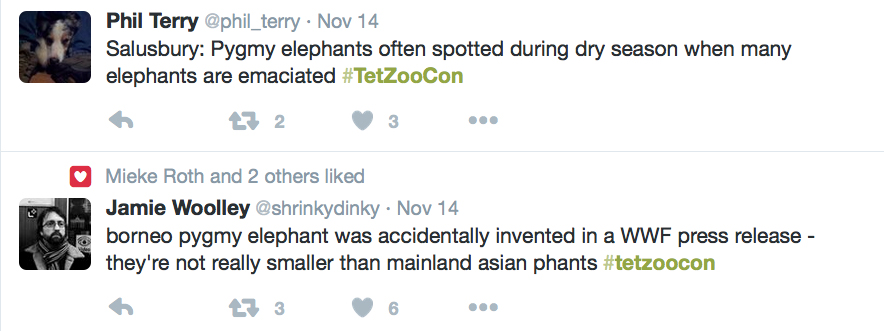


(Paleo-artist Jon Conway is co-instigator of TetZooCon.)


The discussion of how much smaller Borneo elephants are than mainland Asian elephants prompted a virtual exchange with Dr Victoria Herridge, the Natural History Museum's discoverer of Mammathus creticus (and more recently another Mediterranean pygmy elephant), as well as the presenter of Mammoth Autopsy. It ended with a virtual wave to me from Tori.


The revelation that miniature, fist-sized "pygmy elephant" talismans change hands in Thailand and Burma for a lot of money, and their extraordinary source, caused a lot of excitement:


As did the assertion, put about by British big game hunter WR Foran and others, that perfidious French ivory hunters invented the whole "pygmy elephant" thing as a scam to circumvent regulations banning the shooting of juvenile elephants, by claiming that they'd just shot adult (made-up) pygmies instead:


Punters also found the idea of fossil Mediterranean pygmy elephants having litters particularly cool. In answer to a question, I explained that the Spignallo Cave site in Sicily yielded lots of pygmy elephant skeletons, of which many were juveniles or infants. This suggests a high level of infant mortality, and the bit about pygmy elephants having litters of several young was speculation based on this. (Modern African elephants have only one calf at a time, with a gestation period of almost two years. There's a life reconstruction of a juvenile Elephas falconeri here and a "fossil pygmy elephant identification chart" here.)


One of the audience identified with the Sicilian fossil pygmy elephant Elephas falconeri (aka Paleoloxodon falconeri) in particular, as he was from Sicily too (or at least from Italy). (Although his photo actually shows the pygmy stegodon Stegadon floriensis on the left, from Indonesia. Elephas falconeri is here.)

There was also Twitter chatter about "hoaxes involving young", particularly those perpetrated by circus manager PT Barnum, and Ringling Bros Barnum and Bailey's Circus, who had several dodgy pygmy elephants in their menagerie:


The bit about forest elephant females, from their late teens upwards, adopting the orphaned infants who had lost their mothers to poachers after they had weaned also provoked responses. This is in the Dzanga Clearing study of forest elephant behaviour, carried out by the Wildlife Conservation Society in the Central African Republic, which lasted well over a decade. Orphan savannah elephant infants, by contrast, invariably don't survive. (It's thought that a 1982 photo from Congo Brazzaville of a herd of small elephants, with young, is in fact a herd of infants orphaned by poaching and adopted by teenage females. You'll have to read Pygmy Elephants for more information, it includes a reproduction of the 1982 photos of the Congo-Brazzaville alleged pygmy elephant herd.)


There followed Jessica Lawrence-Wujek's talk on why Ichthyosaurs are the coolest reptiles of the Mesozoic. The more you study Ichthyosaurs, the more bizarre they get, particularly their paddles. These started life as the fingers of a limb, but these seem to have sprouted more and more bits out of the sides of what used to be digits as they evolved. They were creatures of the "shallow seas" - seas of around 100 feet deep at the most, but their big eyes suggest they may have been diving further into the dark depths of the Mesozoic waters.

Urban birder David Lindo described how his "Great British Bird" competition elected the robin as Britain's favourite bird - appropriate, as robins behave differently in the UK than on the European mainland. On the Continent, they're forest birds that follow deer or bison, waiting for the to churn up the bugs they feed on. Only in Britain are they garden birds that look to human gardeners to turn up bugs for them. He described the awkward silence in a North American bird hide when he shouted excitedly about seeing a particular type of rare tit. "We call it a titmouse or a chicadee", a North American birder eventually told him.

Vicky Coules recounted The Future is Wild, an After Man-style animated series about the animals that inherit the Earth after we leave (in spaceships to go to a nicer planet, apparently, at the behest of the American network funding it.) Elephantine megasquid colonise the land looking very much like HP Lovecraft's Cthulu. An elephant seal-like giant flightless gannet colonised the frozen regions. Mammals are consigned to history, the last one being a hamster-like "pog" kept as food by seed-gathering spiders. The future Earth includes an Antarctic rain forest, which reminded me of the "Strontium Dog" story from 1980s 2000AD sci-fi comic in which mutant bounty hunters land in an Antarctic rainforest (the result of human-made climate change) and encounter fauna including "monkey-gators".

There then followed the paleoart session on which Naish, Conway and Mark Witton (they all know their pterosaurs!) led us in an illuminating life reconstruction exercise. We were given deliberately badly done cast of one of the Solnhofen pterodactyl casts (one of the people on my table had actually been to Solnhofen) and asked to draw it as a bird, a bat, a reptile or whatever the features suggested. My hopping moorhen with teeth that couldn't fold its wings fully and that had vestiges of fingers used as sort of whiskers to detect wind direction didn't make the top five. Then I had to dash off on Mystery Animals of Suffolk business, I very much regret.

Both Love in the Time of Chasmosaurs and the Scientific American TetZoo blog have excellent reports on TetZooCon 2015.


Wednesday, 26 June 2013

Capture of alleged "kallana" pygmy elephant

An animal described as a "calf elephant, which is purportedly a 'pygmy'" was "tethered" (captured) in February by Kerala Forest Department (KFD) vets in the forest in Paruthypally, in the Trivandrum District of the South Indian state of Kerala.

The capture was covered in The Hindu newspaper of Feb 7 this year and there's also a Malayalam language TV broadcast, which has a fleeting few seconds of a slightly strange-looking elephant moving in the forest, with not much to indicate the scale.

While the traditions of the local Kani "tribals" who live in the Peppara forest describe "kallana" - an agile pygmy elephant five feet in height or less, the Kerala wildlife officials were so convinced that the elephant was nothing of the sort that they "dismissed" a demand for DNA samples to be taken from the elephant. V. Gopinath, Chief Wildlife Warden, Kerala, was quoted as saying "kallana" said "kallana" was "a myth" that "existed in the folklore of tribespeople alone." Another KFD official described the elephant as being a six-year-old calf.

The TV broadcast has a short interview with local wildlife photographer Sali Palode, and shows photos by Sali of his 2005 and 2010 sightings of kallana, including the corpse of an alleged female kallana that he found by a lake in 2005. (This appears in my forthcoming Pygmy Elephants book. The licence I bought for reproduction of his photo doesn't extend to web, but there's a watermarked version of this photo on Sali's website. The Malayalam TV report also has photos by Benny Ajantha and Jain Angadi, who were with Sali when he made his 2010 "kallana" sighting.

There's also a photo by Sali of a strange-looking elephant head-on in The Hindu's report. It's more convincing than any of the other kallana photos I've seen. The Hindu article is sceptical - more so than previously - and uses the word "pygmy" in quotation marks throughout. The article points out that the calf elephant was in a bad way - it "had developed infections" and may have been abandoned by the herd.

When I interviewed Sali in 2011, his agent Balan Madhavan (who acted as interpreter) was emphasising the need for Sali to collect evidence of "kallana" for DNA analysis - dung, hairs and discarded skin from the soles of the feet are the most common bits you find - and the "demand" for DNA samples to be taken from the captured elephant calf at Paruthypally came from Sali. The report adds that "blood samples of the animal have also been collected, which could be used for settling the controversy."

I haven't been able to find out what happened to the elephant since February, or anything about any results from the blood sample, but I am on the case - I have asked the contacts I made in South India, including Balan. I am also looking for a Malayalam speaker to translate the TV report for me. A very early start for me, getting up in time to catch people in Kerala and in Bangalore by phone, is imminent. If I get any answers, I will squeeze this into the Pygmy Elephants book just in time for it to go to press.


A Kerala Forest and Wildlife Department sign - this one's from Neyyar-Peppara. Picture: copyright Matt Salusbury


Monday, 27 May 2013

Fortean Traveller - Kerali kallana capers

This article first appeared in Fortean Times FT 301, May 2013. (It's "Fortean Traveller" no. 85)


The south Indian state of Kerala is officially "God's own country", although I heard that Kerala Tourism appropriated the "God" phrase from a slogan they'd taken a fancy to after seeing it over the stall of a small Latin American country at a travel fair. In March 2011 took a couple of weeks off work and went to Kerala to investigate reports in the local English language press of kallana, the alleged pygmy elephant of that region.

One the attractions of this expedition was that Neyyar-Peppara Wildlife Sanctuary – reputed home to kallana - wasn’t exactly at the ends of the earth, or only reachable after months of trekking through wild and inhospitable jungle. Kallana’s alleged habitat was just 56km from the state capital and the international airport at Trivandrum. It was the equivalent of having a mystery animal in the South Downs just outside Brighton. Compared to the cryptids supposedly living in the wilds of Mongolia or half way up the Himalayas, kallana was right under our noses.

So I found myself in Indian's most laid-back state capital, Thiruvananthapuram, so good they named it twice. "Thiruvananthapuram" was a bit of a mouthful for the British when they moved into the then Kingdom of Travancore, so they adopted "Trivandrum", a three-syllable, anglicised version of city's name. The name means "Holy Snake City", after the huge statue of Lord Vishnu reclining on the serpent Anantha inside the main Padmanabhaswamy temple downtown. I only saw a drawing of its interior - like many Hindu temples in India, it's "closed to non-devotees."

It being India, getting hold of my star interviewee and kallana eyewitness Sali Palode proved complicated. He wasn't answering his agent's phone calls. Sali's non-availability gave me the opportunity to go upstate to briefly see some young captive elephants at Kodanad Elephant Camp, a facility for rescued elephants being trained for work in forestry and tourism. It was good to get up close to them, and to compare young conventionally-sized elephants with photos I'd seen of “kallana.”


A young captive elephant and his mahout in the Periyar River, Kodanad, Kerala

I naively imagined that elephants approaching would make the ground shake with their great feet, like something out of Godzilla. But as I stood on the banks of the Periyar River, watching the younger elephants being bathed by their mahouts, the only indication that another elephant - a tusker who must have been over eight feet high (almost 2 ½ metres) – was right behind me and gracefully advancing down the riverbank towards me, was when his mahout put his hand on my shoulder and politely asked me if I could get out of the way. The eight-foot tusker moved completely silently.

I was also mistaken in my belief that young elephants loved going into the river for a bath. They absolutely hated it. The mahouts somehow managed to subdue these beasts - that could have crushed them with ease - just by gently pulling their tails.

Down the road from the Kodanad was the sad little Kerala Forest Department (KFD) zoo for "rescued" animals, which was, frankly, a disgrace. Just down the road from that, however, the finishing touches were being put on its replacement, a spacious park with big enclosures where herds of animals could run in a near-wild state. Some of the deer had been moved in, and the chief warden of the "rescue centre" said its first rescued elephant was due to move in within a few months.

The warden, with some pride, asked me if I'd spotted another Kerali pygmy, "our own dwarf muntjac deer," as if his herd of little dog-sized, short-antlered, fanged, barking muntjac deer were the most exotic animals on the planet. I had to break it to him that, while muntjac may be native to Kerala, they were introduced to the grounds of English stately homes some time ago, from which they escaped and have now become so common they're widely regarded as vermin. To this the warden replied, with a wry smile, "That is the consequence of your folly!" He was presumably referring to the British conquest of India, and Britain's karma for this series of atrocities is being overrun by Indian muntjac.

Sali Palode's agent Balan Madhavan had finally tracked him down. I met them both at the Trivandrum Press Club. It was a noisy interview, as retired journalists - wandering in and out of the reading room where we talked - would interrupt to greet Balan. Sali was shy and retiring with short grey hair and glasses, and spoke quietly in Malayalam, with Balan's deep, more confident voice, interpreting for me in English.

A drawing teacher for the past 25 years, Sali taught at a Malayalam-medium school near the mountain town of Palode in the hills not far from Trivandrum, on the edge of the forest near where he grew up. From an early aged Sali would trek in the forest with his father or with friends form the local Kani "tribal" community. He eventually managed to borrow some photographic equipment and take photos of the wildlife he saw. He's since won over 70 awards, but Balan said all the money Sali's made from photography has been ploughed back into the kit, like the huge Canon lens I saw him use when we later went into the forest together.


Sali Palode at work with his camera in Neyar-Peppara Wildlife Sanctuary

Where did Sali first hear about kallana, I asked. From the "tribals". It was "25 years back, on a trek to the Agustya mountains, on the top." There Sali and his Kani guide Mallan Kani saw "small elephant droppings" that "belong to kallana."

Since that encounter a quarter of a century earlier, Sali and Mallan have been looking for kallana. Sali described how he first "got a picture in 2005" of a kallana, one of a group of four, (FT 252;42-47) and also photographed what he says is a dead adult female kallana by a lake. Kallana's stomping grounds are in the Neyyar-Peppara reserve, among the Agustya Mala hills, which have become a Hindu pilgrimage centre, and Sali says kallana is moving down from the higher altitudes due to "human intervention" on the hills. The animal is agile, and climbs uphill very fast, a feat which Sali has seen himself.

Sali pointed out that his kallana photos show "long limbs" and that "the skin is wrinkled", which he says is evidence that they're adults. What convinced Sali of that adulthood of the "tusker" male he photographed in 2010 were "skin details… long tail, really hairy". And then there were the tusks – certainly more developed that the ones I'd seen on younger elephants at Kodonad.

The search for one cryptid usually throws up some other unexpected mystery animals as well. Sali said a Kani elder had shown him another Kerali cryptid, a purple-bodied tree crab that lives in "gaps on trees". The Kani use this mystery tree crab as "medicine, for the ears". Balan mentioned another Kerali cryptid – the pogeyan, the "clouded leopard", an alleged smoky brown-grey leopard without spots, dwelling in the far north of Kerala, in grassland and "evergreens" of the Munnar region and moving in and out of the tea plantations of Malabar. He knows one forest officer who's seen a pogeyan.

"Warden Sharma" the Trivandrum District Chief Wildlife Warden, after an explanation from Balan of what we wanted to do, gave permission for me to enter the Neyyar-Peppara sanctuary, but only for the day, and only if accompanied by Sali and his guide, Mallan Kani.

Next day I got up very early for a possibly inadvisable 40km trip by motorized rickshaw turbo milk float, which meant I arrived ten minutes late for our rendezvous with Sali at the hill town of Vithura. As we passed a shiny suburban showroom for the new Indian-built Tato Nano economy car, my rickshaw driver said with disdain that his vehicle exceeded the 70kph maximum speed of a Tata Nano.


Sali Palode (left) and Malan Kani (right) in Neyyar-Peppara sanctuary, at the spot where they found the dead kellana in 2005

Soon Sali and I stood before the green and red sign of the Kerala Forest Department at the entrance to Neyar-Peppara Wildlife Sanctuary, where Sali's guide Mallan Kani was waiting. Mallan was a more outgoing character, and he and Sali had a Malayam-language Laurel and Hardy camaraderie thing going, as they marched off ahead through the thick forest at a brisk pace I could barely keep up with. "Faster!" Mallan would occasionally call to me. They had to wait for me once when I got my ear impaled on a dangling thorn.

We went through paddies and low-impact cashew and rubber plantations, and past an anti-elephant trench and Kani houses with solar panels. Then uphill and into deep forest. The trail was steep and narrow, and single-file. Mallan said it was an elephant track. It was difficult enough for humans, only the piles of elephant dung – with mushrooms growing out of it – told us these were elephant paths.

The forest was humid and I was sweating buckets by now. My heart was racing – it could be the altitude. Brilliant blue and white butterflies flitted around us, and there were biting ants that drew blood if you were foolish enough to sit down for long. Strange hooting whistling laughing birds called to us, one sounded like Mutley out of Wacky Races cursing.

Mallan took us on a steep downward descent to the spot where they found the body of the female elephant in 2005, by a lake with the Agusthya Mala in the distance behind. Then Mallan suddenly said, “Gaur! Guar!” although Sali and I saw and heard nothing, and he then disappeared into the forest, after getting Sali and I into cover behind some trees. Sali took out his massive Canon lens and screwed it into his camera, and crouched in the trees just ahead of me at the forest's edge.


Herd of gaur (wild Indian bison) stampede past


Ten minutes later came a thundering of hooves, and curly-horned gaur – wild bison - in a big herd appear to charge straight at us. Sali got up and started running. I decided to stay put, reasoning that the trees would stop them charging directly at me. They veered to the left and charged uphill – beards, calves and all, about 20 in total. Sali was running after the herd, camera at the ready. I missed most of it, having got tangled in a thicket. Following in the wake of the gaur came a cloud of stinging flies. Sali ripped a branch off a bush, and beat them away. Mallan re-appeared.

It seems he'd flushed out for the gaur for our benefit. Mallan's forestry skills were impressive. Some say that “kallana” are just young elephants playing a short distance from a herd that’s unseen and close by, but if the herd were close by, Mallan would know about it.

We were finished by 11.30. We stopped at the next Kani settlement. Plastic chairs were produced for Sali and I, and with a little bamboo ladder, one of the Kani neighbours went up a tree to bring down fresh coconuts for lunch, a rare privilege as access to "tribal" areas is usually restricted. Sali and I bade farewell to Mallan at the Forest Dept. post by the sanctuary's entrance. It was still lunch hour when two short bus rides later I was back in Trivandrum.

Sali and Balan have been tracking kallana for at least a decade, and had only three encounters and one dodgy sighting of its dung. The chances of me tripping over kallana – or even a conventional elephant – in the thick, thick forest, were never great.


Back in Trivandrum, I encountered statues of what were described as “unicorns” or “elephant dragons” – horse-bodied, eagle-clawed beasts with elephants’ heads, often associated with a small elephant that accompanies them.

Some grasped their trunks in their talons, some had trunks reaching down towards considerably smaller “baby elephants” whose trunks reached up to theirs. Some had small crests or tufts on their heads. Some had multiple tusks growing out of the sides of their mouth where their teeth should be, like the mouthparts of a monster prawn.

There were "elephant dragons" in the Maharaja of Travancore’s eighteenth-century palace, and in the huge temple next door. The palace and temple guides told me the "elephant dragons" were carved in the late eighteenth century, during Travancore’s zenith. I was told the makara are not exclusive to India, and there's been little research into their origins. Makara feature fleetingly in Bernard Heuvelmans' In the Wake of the Sea Serpents, but as sea creatures. The makara in Trivandrum, and on the coat of arms of the neighbouring State of Karnataka – were definitely land animals.

I also spent 24 hours in Bangalore, to see Asian elephant expert Prof. Raman Sukumar at the Indian Institute of Science, a university campus so vast it has its own airstrip.


Asian elephant expert Prof. Sukumar Raman

"Don't, whatever you do, come on the 31st of March, it's the end of the financial year," advised Prof. Sukumar. The Union Government in New Delhi demands all taxes are paid by the end of this date on pain of considerable penalties. The last day of the financial year is bedlam. Most banks are open all night for receipt of government revenues, still mostly done in cash. Sukumar has to reconcile the accounts of the IISc's Institute of Ecology he heads - by the end of a very long day. So we met on April Fool's Day instead.

Prof. Sukumar Raman is the expert on Asian elephants, but like every head of department he had a lot of admin to deal with. As well as having to sign leave requests for departmental staff during our interview, Sukumar was interrupted by a bizarre marketing call from a mobile company, following an inquiry about billing for SIM cards. It turned out the two SIM cards they were talking about were “for elephants” in radio collars awaiting deployment on elephants in West Bengal. He told me he had a hard time explaining to the mobile company that he didn’t know the mobile numbers for the SIM cards, as they were radio-tracking devices for elephants, and no, they didn't want free weekend calls...

Sali Palode's website has his photos of kallana, and of the tree crab (the latter on the "Insects" page).


This is an edited extract from Pymgy Elephants – on the track of the world's biggest dwarfs, published by CFZ Press later this year.

© Matt Salusbury 2013

Tuesday, 11 September 2012

Slight delay - meanwhile Oslo dwarf hippo, Oxford juvenile elephant

Pygmy Elephants is now expected to be finished and handed in to the publisher in early October. The original plan was to hand it in during Weird Weekend in mid-August, which came and went with no book finished.

Some work is still needed on the prehistoric pygmy elephants chapter, "incredible shrinking mammoths" (palaeontological evidence suggests the mammoths were getting successively smaller over their last generations in Siberia and Wrangel Island, and in other, earlier populations too), and on the "island dwarves, island giants, island forests" chapter.

On the subject of island dwarves, I saw this skeleton of Hippopotamus madagascariensis, the dwarf hippo of Madagascar, at the Natural History Museum, Oslo, It may have been finished off by the first arriving humans on the island. The skull is about a third the size of an adult conventionally-sized hippo's skull.


There are still a few things that need looking up and/or checking again before Pygmy Elephants can go to press - a source regarding a German team of anthropologists from the University of Gottingen, said to have filmed a group of pygmy elephants in the Central African Republic in the 1980s whilst studying the Binga people of the forest, Lucien Blancou and his apparent change of mind on whether there are pygmy elephants, and so on.

I've been busy. Zoologist Lars Thomas, who uncovered for me two skulls of alleged female pygmy elephants that had lain forgotten in the University of Copenhagen Museum, was a speaker at Weird Weekend. He told me at WW that he could put his arms round these skulls, while the museum had skulls of adult Loxodonta cyclotis (forest elephants) that he couldn't even lift off the ground. He says there's also the hardened, dried skin of one of the alleged South Cameroon pygmy elephants, and doesn't rule out a DNA sample eventually. The University of Copenhagen is gaining something of a reputation for DNA analysis, so they've got a bit of backlog right now!

Palaeontologist Darren Naish and zoologist Max Blake, also at Weird Weekend took a look at Lars' photos of the South Cameroon skulls and agreed - based on the limited information available - that they seemed to be of an adult or sub-adult. I may also have found someone to write a foreward to the book.


I saw the above reconstruction in a display at the Natural History Museum, Oslo of Elephas falconeri, aka Paleoloxodon falconeri, the smallest known pygmy elephant, from Sicily, around 100,000 years ago. The reconstruction here has a big domed head, although at least one recent description of E. falconeri points out that its (proportionally big) head isn't as domed as its mainland ancestor.

I also recently visited the Museum of Natural History, Oxford, where there's a skeleton of a three-year-old infant Asian elephant, interesting to compare it to alleged pygmies. As can be seen from the skull, the sutures aren't yet fused. A lot of the tusk development on this skeleton - if not all of it - won't have protruded from under the gums. The human standing next to it is almost exactly my height - just over 6ft 3.


All photos copyright Matt Salusbury